Women Garden

Chemistry

Chemistry

Chemistry

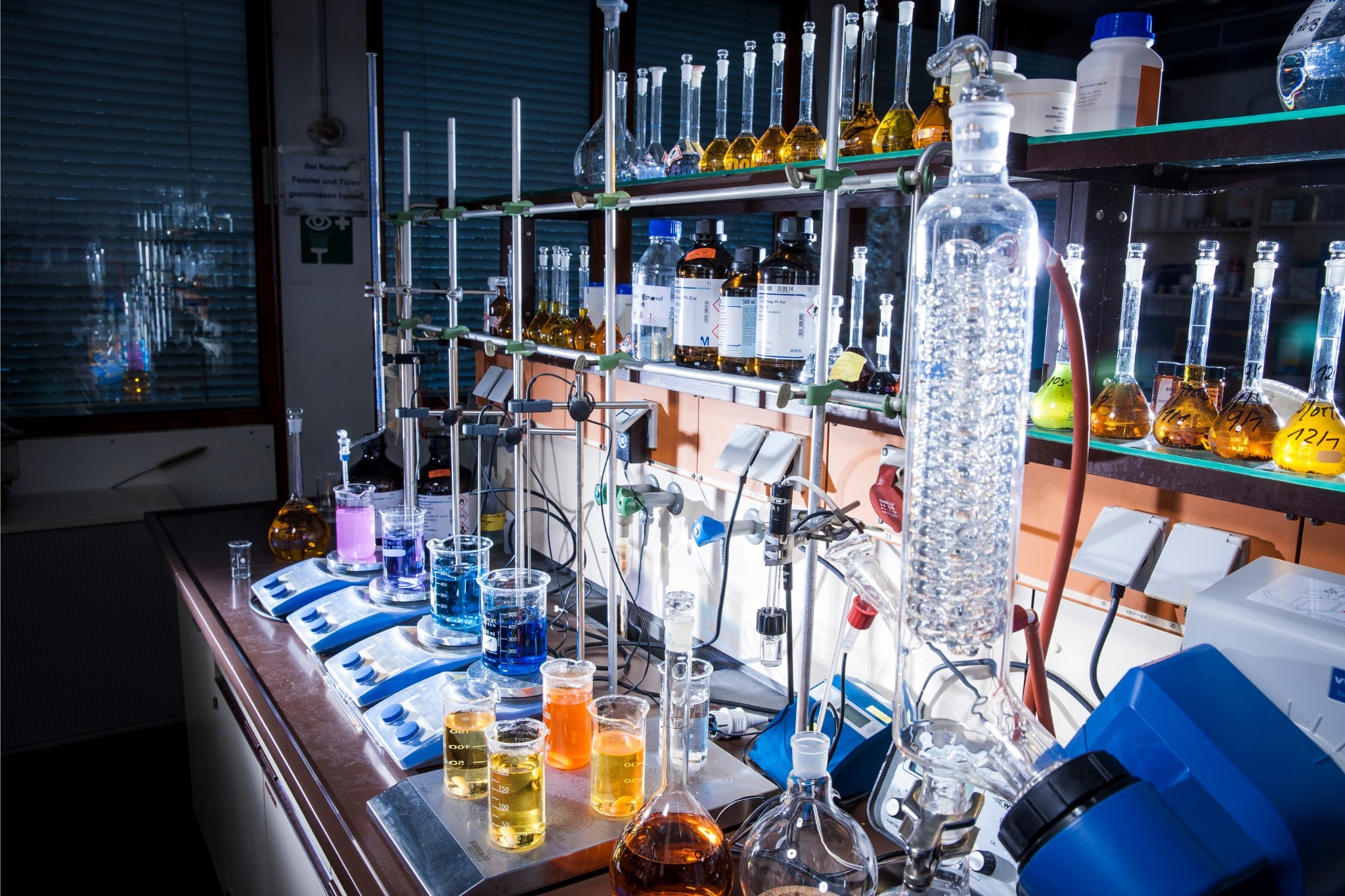
The chemical department reflects TDW's position as a unique integrated warhead system manufacturer — with pilot plant and laboratories applying modern analytical methods to international standards for high explosives.

Integrated Capability

Chemical and physical laboratories combined with a dedicated pilot plant for explosive formulation and casting.

International Standards

Analyses in accordance with STANAG, MIL and TL requirements for high explosives.

Full Life Cycle

From incoming raw material inspection to surveillance and life extension programmes.

Prototype Production

Manufacturing of prototype warheads and development of upgraded high explosive composites.

Chemical Analysis

Chemical Analysis

Chemical Analysis

Our chemical laboratory provides comprehensive analytical capabilities for raw materials, intermediates and finished explosive formulations. Automated titration systems determine acidity and basicity of pure materials and mixtures. Karl Fischer titration measures water content with high precision. Gas chromatography and HPLC enable separation, identification and quantification of compounds. Fourier Transform Infrared Spectroscopy classifies and identifies substances at molecular level.
Modern speaker on a table

Physical Analysis

Physical Analysis

Physical Analysis

Our pilot plant capabilities cover the complete process from the preparation of polymer-bonded explosive formulations to the production of prototype warheads under controlled and safety-certified conditions. PBX mixtures are manufactured using planetary vacuum mixers with batch volumes of 1.5, 5 and 25 litres and are subsequently vacuum cast for development and qualification testing. Drying and curing are carried out in facilities compliant with VDE 0166 (Ex-E1) and ATEX 95 regulations, ensuring safe, reliable and reproducible manufacturing throughout the entire production process.
Modern speaker on a table

Pilot Plant

Pilot Plant

Pilot Plant

Our pilot plant capabilities cover the complete process from the preparation of polymer-bonded explosive formulations to the production of prototype warheads under controlled and safety-certified conditions. PBX mixtures are manufactured using planetary vacuum mixers with batch volumes of 1.5, 5 and 25 litres and are subsequently vacuum cast for development and qualification testing. Drying and curing are carried out in facilities compliant with VDE 0166 (Ex-E1) and ATEX 95 regulations, ensuring safe, reliable and reproducible manufacturing throughout the entire production process.
Modern speaker on a table

Material Science

Material Science

Material Science

Our material science laboratory characterises the mechanical and microstructural properties of metals, polymers and composites used in warhead construction. Multiple hardness testing methods cover the full range from Brinell and Vickers to micro-indentation. A universal testing machine performs tensile, compression and bending tests from −60°C to +100°C at forces up to 100 kN. Scanning electron microscopy up to 5,000× magnification combined with energy dispersive X-ray spectroscopy provides qualitative and semi-quantitative composition analysis.
Modern speaker on a table

ENGINEERING THE FUTURE OF DEFENCE

We work closely together with our partners to develop tailored solutions and support every phase - from concept to fielding.